



(This post is part of History of Ideas, a series on the people whose thinking shaped Montana’s experimental treatment model. Many of them proposed versions of it from inside the system, years before it became law. In this series, we’re uncovering their story.)
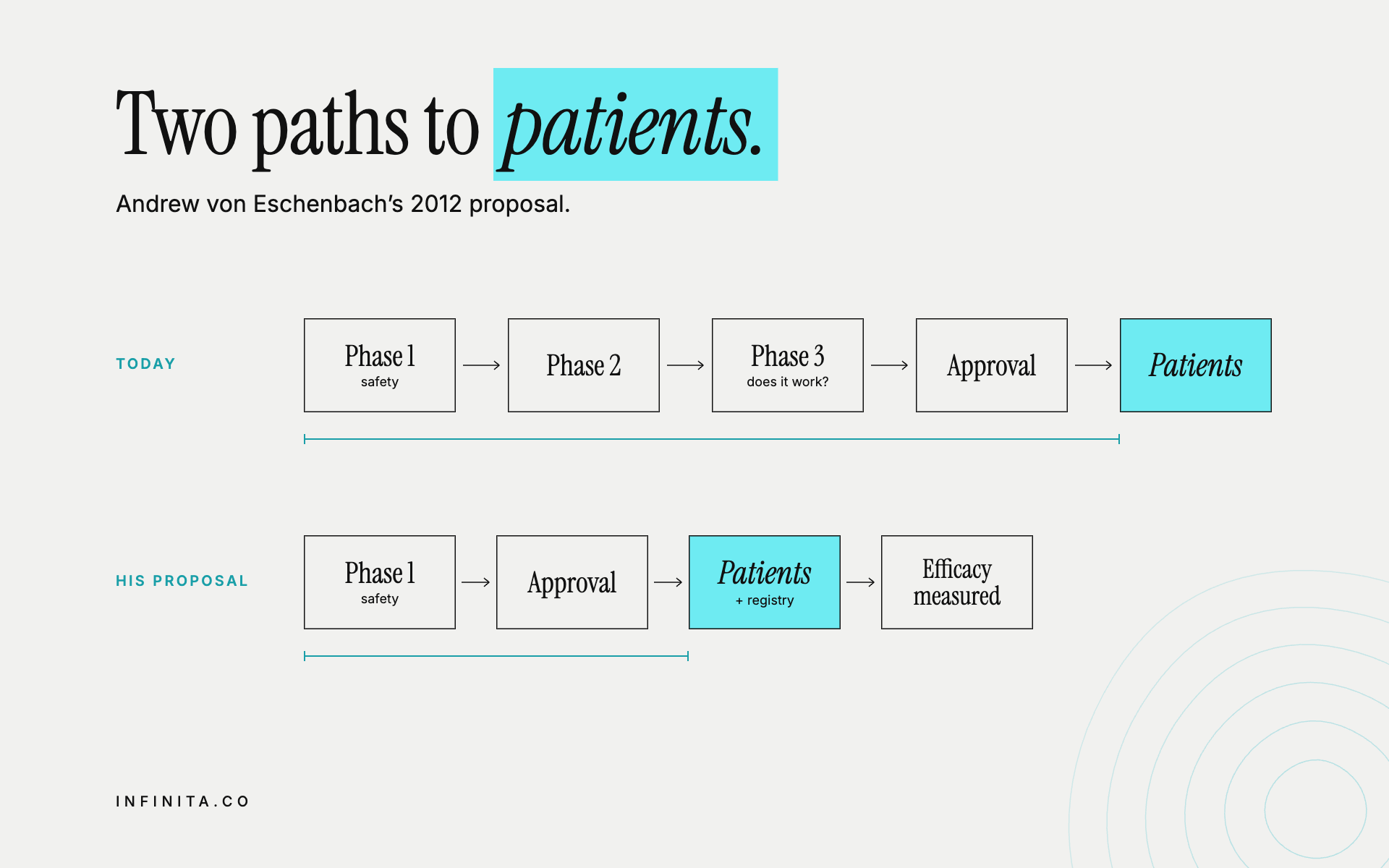
In 2012, a former FDA commissioner, Andrew von Eschenbach, argued that patients should not have to wait years for proof a treatment works if we already know it is safe. His proposal was to approve promising therapies after safety testing, enter every patient in a registry, and measure efficacy after approval. The idea never became federal policy.
In 2025, Montana built a state framework on the same sequence.
Who he was
He spent 26 years at MD Anderson treating cancer patients. In 2002 he became director of the National Cancer Institute. In 2005 he was named acting FDA commissioner and ran both agencies at the same time for six months.
The Senate confirmed him 80 to 11 in December 2006, and he led the FDA until January 2009.
The idea: approve after safety, track every patient
His central example: a retina therapy approved after safety testing, tracked through a registry
His example was a lab-grown cell therapy that repairs the retina in patients blinded by macular degeneration. Instead of waiting years for efficacy trials, it could be approved “after proof of concept and safety testing,” with every patient entered in a registry. He laid this out in the Wall Street Journal in February 2012.
Trials from 2003 to 2006 ran nearly 70% longer than four years earlier
Why he thought it was needed
After drugs like Vioxx showed unexpected side effects, the FDA began requiring larger trials. Longer trials raised costs and discouraged investment in new therapies.
In a 2013 FDA oral history interview, he called the traditional randomized trial “a statistical fabrication to try to reduce bias,” built for a time when doctors could not tell patients apart. He was clear he was not proposing to eliminate trials, only to add a second path.
The pushback
Critics doubted that data collected after approval would hold up:
Post-market studies: companies already fail to complete many of the studies the FDA requires after approval, noted health industry writer Merrill Goozner.
Phase 3 matters: in 2017 the FDA published 22 cases where promising Phase 2 results did not hold up in Phase 3.
Japan moved first
In 2014, Japan introduced a conditional, time-limited approval for regenerative medicine.Therapies could reach patients after proof of safety and a signal of effectiveness, with efficacy confirmed afterward.
The US never created a pathway like it.
Montana followed in 2025
In 2025, Montana became the first US state to license facilities to administer therapies that have completed Phase 1.
Each center works with an experimental treatment review board, and those boards must publish annual summaries of the treatments reviewed, safety outcomes and serious adverse events.
Montana’s framework doesn’t grant FDA approval, and it only applies to licensed centers in one state. But the sequence is the one von Eschenbach proposed: access after safety testing, with outcomes tracked along the way.
In 2012, it was an op-ed. In August 2026, Montana approved its first treatment protocol built on the same idea.