



Montana’s experimental treatment pathway covers medical devices as well as drugs.
Under the state rules in effect since July 25, 2026, an “investigational medical device” is any device that meets the state’s definition of experimental treatment. That includes devices with health-tracking or data-monitoring functions.
Devices are tested differently and don’t go through Phase 1, so the Montana Experimental Treatment Review Board (ETRB) judges their studies using its Phase 1 equivalency guidance.
Every device is reviewed for risk before it reaches patients
The center’s ETRB reviews the protocol and evaluates each device’s level of risk, including whether it is safe to use outside the center.
Centers need the right equipment and trained staff
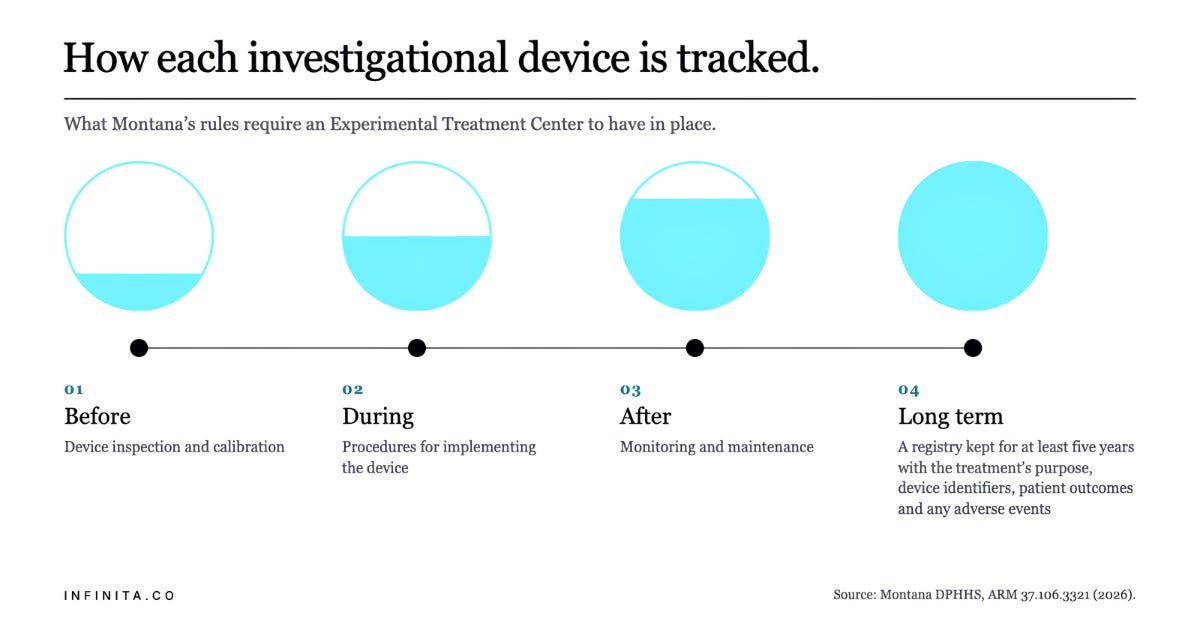
An Experimental Treatment Center (ETC) must maintain specialized equipment and facilities to implant, monitor or administer devices.
Providers need documented training and proven competency for each device procedure.
An ETC inside another health care facility must run as a separate unit with its own staff. Only ETC staff can access its devices.
Device consent covers more than standard consent
On top of the consent every patient gives, device patients must be told about:
→ the risks of implanting and removing the device
→ long-term monitoring requirements
→ how it interacts with other devices or treatments
→ for smart devices, what data it collects, how it transmits that data, and its cybersecurity
Malfunctions, recalls and connected devices have their own procedures
Centers need written procedures for malfunctions, emergency removal, adverse event reporting and recalls.
Connected devices also need policies on cybersecurity, data privacy and patients’ access to their own device data.
Device performance and safety are reviewed regularly through the center’s quality assurance program.
Low-risk devices may be used outside the center
If the ETRB finds a device has minimal risk and is safe to use outside the center, the ETC may make it available to private practicing physicians under a signed agreement.
The physician must document outcomes, report adverse effects to the center within 24 hours and renew the agreement every year.
Simpler devices may be easier to place than surgical ones
Because ETCs must be set up as dedicated facilities, devices that require surgery could be harder to place in practice.
Steve Martin, Infinita’s US lead, has said the easier a treatment is to administer, the easier it may be to find a center able to offer it.
If you have any questions about Montana, you can book a call with Steve.