



Montana has created a new pathway for patients to access experimental treatments that have completed Phase 1 but are not yet FDA-approved for general use. Unlike traditional early-access pathways, it is open to all patients and allows biotechs to charge for treatment, creating an opportunity to generate revenue and real-world data that can support later-stage clinical development.
If your treatment has completed Phase 1 and you want to offer it to patients through Montana’s experimental treatment pathway, the first step is a review by the Montana ETRB.
Here’s how it works.
Before You Start
Check that your treatment fits Montana’s definition. Under SB 535, an experimental treatment is:
“the provision of a medical intervention by a health care provider involving an investigational drug, biological product, device, or other treatment that has successfully completed phase 1 of a clinical trial but has not yet been approved for general use by the United States food and drug administration and either: (a) remains under investigation in a clinical trial approved by the United States food and drug administration; or (b) has a demonstrated safety record through documented clinical evidence from a qualified medical institution as defined by department rule.”
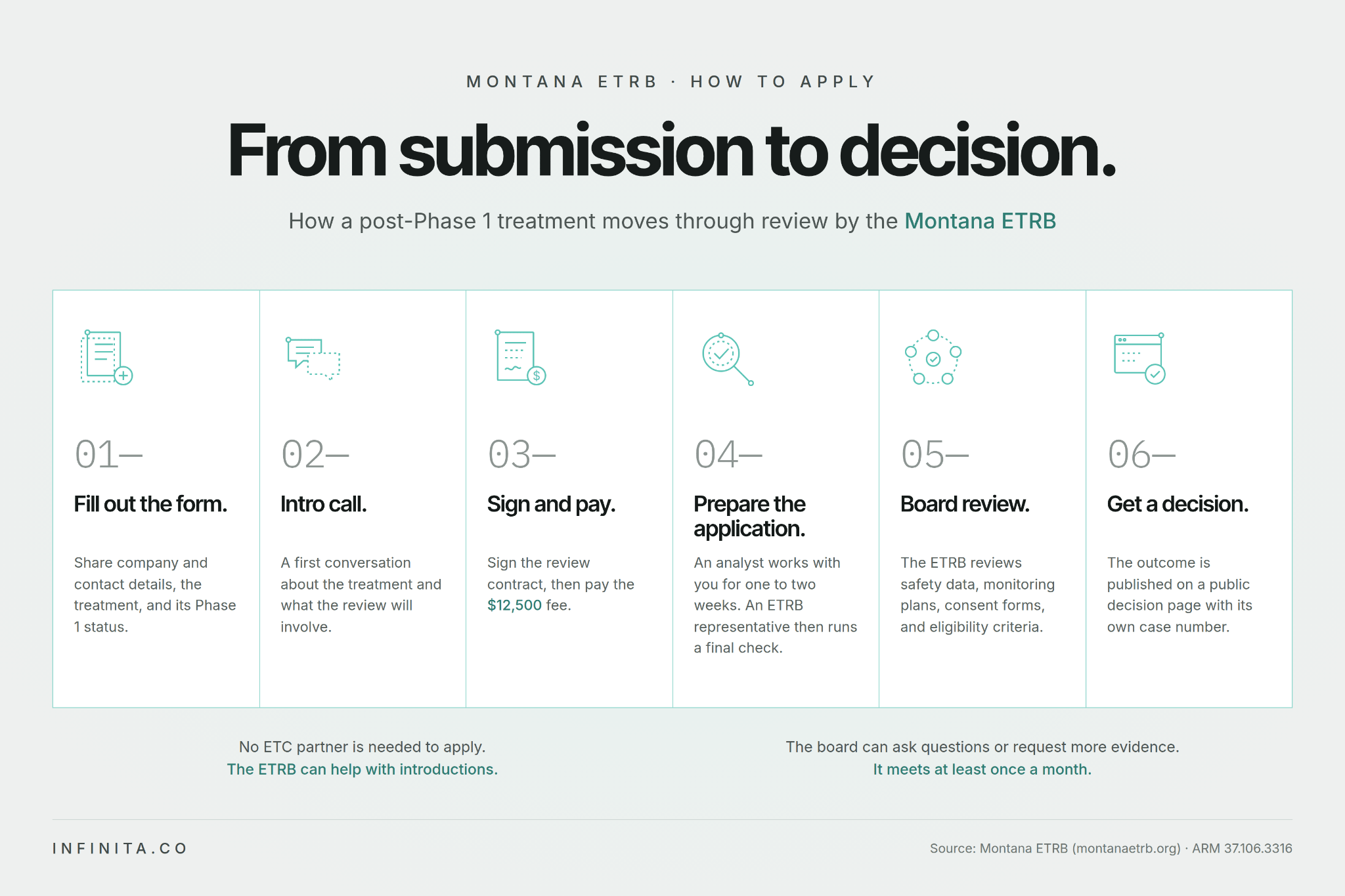
Step 1: Where do you start?
Start with the submission form on the Montana ETRB website. Add who is applying (the company, its location, and the representative’s contact details) and what is being submitted (the treatment, the indication it’s meant for, and its Phase 1 status).
Step 2: Pass pre-review
After the form is submitted, the ETRB team schedules an introductory call. It’s a first conversation about the treatment, the company’s plans, and what the review will involve.
Step 3: Pay the fee
Next, the company receives a review contract. Once it’s signed, the company pays the $12,500 review fee, usually by wire transfer.
Step 4: Pass pre-review
An analyst works with the company for one to two weeks to prepare the application. Once it’s ready, a representative of the ETRB runs a final pre-review check before the case goes to the full board.
Step 5: Board review
The ETRB reviews safety data, monitoring plans, consent forms, and eligibility criteria. If the board needs more information, it can request additional evidence before reaching a decision. It can also approve a protocol with conditions, such as additional patient monitoring.
Under Montana’s rules, the board meets at least once a month, and timelines depend mostly on how complete the submission is. Most reviews take shape over a few weeks.
Step 6: Get a decision
The board issues a decision letter, and the outcome is published on a public decision page with its own case number.
Anyone can open it without an account, so companies can link to it from their own websites and let partners and clinicians verify the review.
The first decision under SB 535, for Parley Neurotech’s combination therapy, was approved with conditions in August 2026.
Good to know
An ETRB approval is not FDA approval, and it doesn’t determine whether a treatment works. What it confirms is that the protocol meets the safety, monitoring, and consent standards Montana’s rules require.
You don’t need an agreement with an Experimental Treatment Center (ETC) to apply. To treat patients after approval, you’ll work with a licensed ETC, and the ETRB can help make introductions.
For a small biotech with Phase 1 data in hand, the path looks like this: check eligibility, submit, work through the review, and come out with a public decision it can build on while development continues.