



In August 2026, the Montana Experimental Treatment Review Board (ETRB) issued its first decision under SB 535, approving a treatment protocol for use in Montana medical practice.
“Approved” is a big word in medicine.
Most people hear it and think of the FDA, of a pill at the pharmacy, of something a doctor will recommend. An ETRB approval is something different, and these are five things it does not mean.
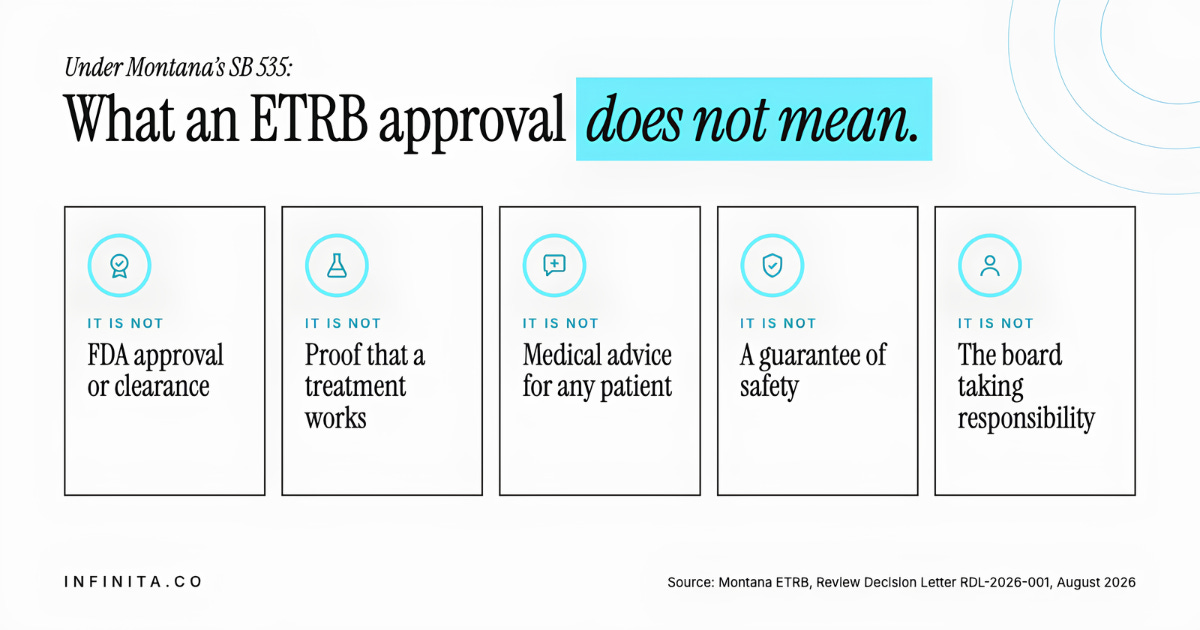
1. It is not FDA approval
ETRB approval is not approval or clearance by the U.S. Food and Drug Administration (FDA). The ETRB is an independent board of physicians, scientists, and ethicists, not a not a government agency. Its decisions apply to medical practice in Montana under state law.
2. It is not proof that a treatment works
An ETRB approval is not a determination of efficacy or therapeutic benefit. Whether a treatment works, for whom, and at what dose are the questions clinical trials exist to answer, and many of these treatments are still being studied in trials.
The board’s role is to review the record a company submits, including whether its risk-benefit analysis shows a reasonable safety profile.
3. It is not a recommendation to any patient
An approval is not medical advice. It doesn’t tell anyone they should take a treatment. That decision still happens between a patient and their doctor, who knows their history, their other options, and the risks that matter for them.
4. It is not a guarantee of safety
An approval is not a warranty that a treatment is safe. A review can weigh the evidence available at the time, but it can’t predict how a treatment will behave in every patient.
5. It does not make the board responsible for the treatment
The board doesn’t make treatments, supply them, or give them to patients. Responsibility for development, manufacture, supply, and clinical delivery rests with the company, the experimental treatment center (ETC), and the treating providers.
So what does it mean?
An ETRB approval means a board of physicians, scientists, and ethicists reviewed the evidence a company submitted and decided its treatment protocol can be offered in Montana medical practice, and can attach binding conditions to it.
Approvals apply only at ETCs that designate the board in a written agreement. In the board’s first decision, the approval also took effect only after the Chair confirmed in writing that its conditions had been met.
You can read the full Review Decision Letter, RDL-2026-001, here.