



Say a treatment has finished Phase 1 but isn’t FDA-approved yet, and a patient in Montana wants it.
Who decides whether it’s safe to offer? And who actually gives it to the patient?
Under Montana’s SB 535 , and the state rules in effect since July 2026, those are two separate jobs: one for Experimental Treatment Centers (ETCs), one for Experimental Treatment Review Boards (ETRBs).
The ETC: where treatment happens
An ETC is a clinic licensed by the Montana Department of Public Health and Human Services (DPHHS) to offer experimental treatments. It can’t operate without that license.
Every ETC needs a medical director: a Montana-licensed physician who oversees treatment, tracks every experimental treatment and its outcomes, and serves as the center’s safety officer.
Before any treatment, the center and the patient sign a written agreement listing the treatment, its clinical trial phase and all expected costs. The center reports serious adverse events to DPHHS within five days and files an annual report.
The ETRB: where protocols are reviewed
An ETRB doesn’t provide treatment. It reviews treatment protocols for therapies that have finished Phase 1 but aren’t FDA-approved yet. Most are submitted by the company developing the therapy. Before an ETC can offer one, the board checks safety, informed consent, risks and benefits, and alternative treatments.
Its members include a Montana-licensed physician, a clinical outcome data expert and an ethicist, and none can have a stake in the centers they review. After approval, the board keeps reviewing adverse event data.
Here’s a closer look at how the review works.
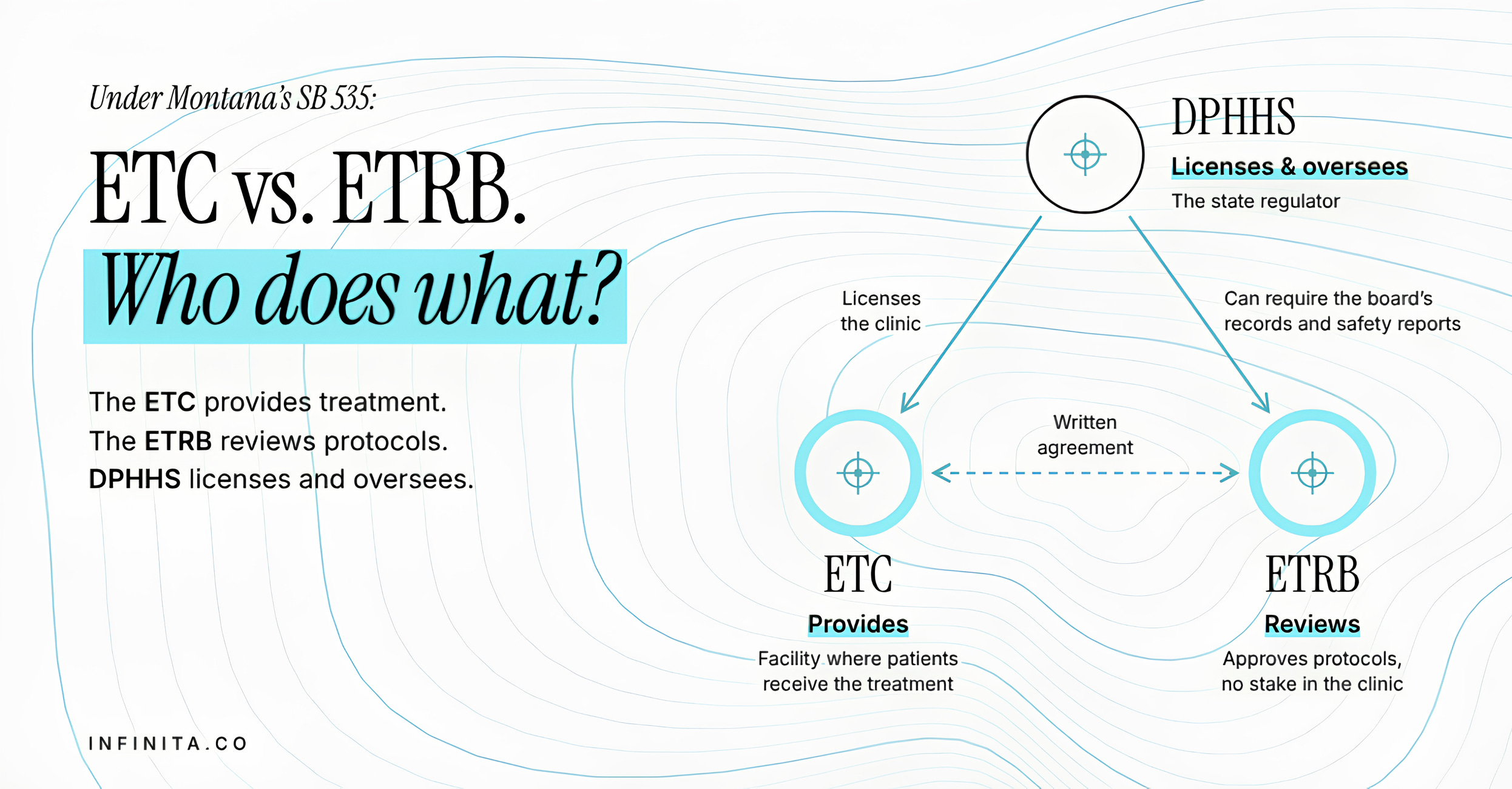
How the two connect
Every ETC must set up or contract with an ETRB. One board can serve several centers, as long as each center designates it in a written agreement. A center can receive a provisional license without a board, but it cannot treat anyone until one is in place.
Once a board approves a protocol, the treatment can be offered at the ETCs that work with that board. Approval doesn’t oblige any center to offer it. The company and the clinic still have to agree on terms.
Above both: the state
Neither the ETC nor the ETRB is the regulator. DPHHS is.
It issues ETC licenses, can take action on them, receives adverse event reports, and can request the board’s records and safety reports.
The ETC provides treatment. The ETRB reviews protocols. DPHHS licenses and oversees.